

vulnerability
Blog post
1Password's AI patching benchmark is misleading
Source: Trail of Bits Blog · Published · Last checked 3 hours ago · 3 min read
Publisher excerpt From Trail of Bits Blog
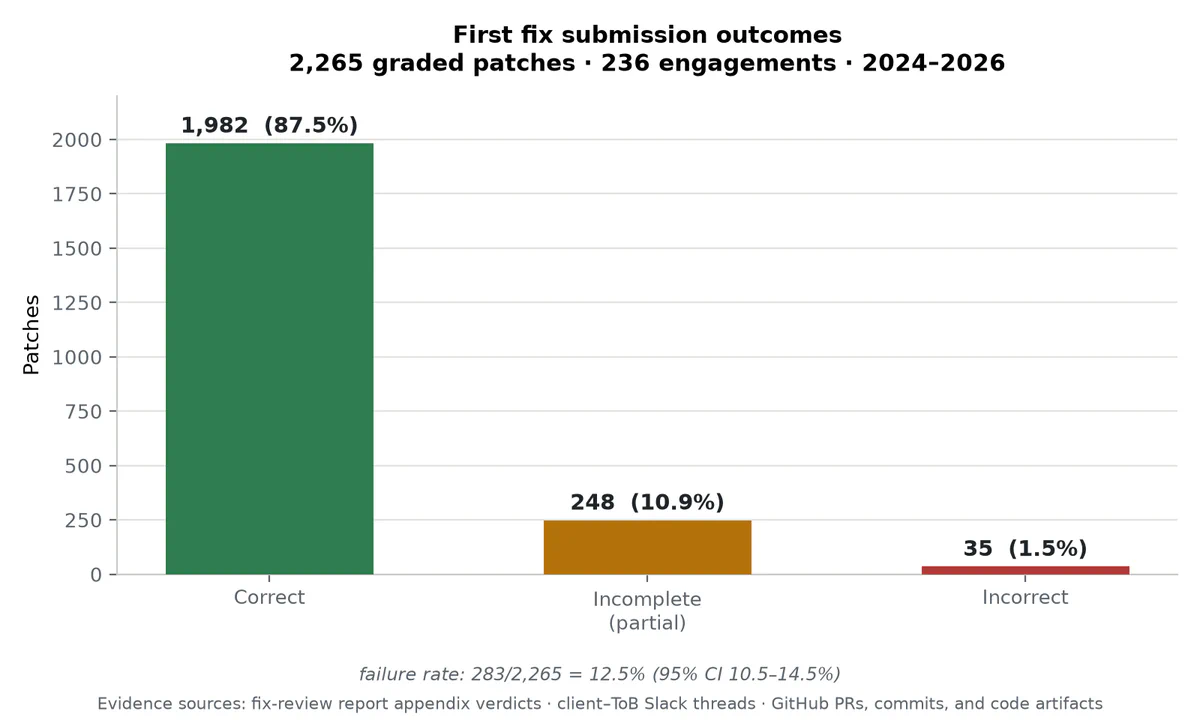
1Password’s FLAWED report, published on August 6, 2026, gives defenders a misleading picture of AI patching. Its headline says models produced clean fixes only 26% of the time. That figure includes experiments that deliberately instructed agents to apply the wrong fix, along with experiments in which agents could not compile or test their patches. The report risks making defenders less effective by discouraging them from using technology that could help them fix more vulnerabilities. Teams that take its headline at face value may leave repairable vulnerabilities unaddressed. We want our work to help defenders fix more vulnerabilities. This post shares real-world data on human and agent patch quality from our consulting projects and Patch the Planet. We’re also releasing two agent skills: post-patch-validation to help agents test fixes, and review-walkthrough to help engineers review them. How the experiment produces a misleading headline Our review of 1Password’s code and data found four choices that make its 26% clean-fix rate a misleading guide to ordinary patching work.1 The sample was selected for difficult fixes. The authors chose six vulnerabilities because their fixes were complex. Clean-fix rates ranged from 3% to 60% across those bugs, so the average depends heavily on which vulnerabilities made the list.2 Two prompts tell agents to apply the wrong fix. Those prompts account for 22% of the data. Combining them with ordinary repair attempts makes the reported rate depend partly on how often the researchers chose to give agents bad advice. More than a third of the trials prohibit testing. One evaluation mode prevents agents from building or running code and accounts for 36% of the data. The headline combines those trials with experiments in which agents could test their patches and act on the results. The models ran at different reasoning settings. GPT-5.5 ran at medium effort and Opus 4.8 at high. These were the tools’ defaults. Neither model was tested at its highest available setting, and the authors did not measure how increasing effort affected the results. 1Password’s headline also obscures a useful result in its own data. We reanalyzed the patches and recorded test results published with the study, keeping trials where agents could run code and were not instructed to apply the wrong fix. In those trials, 2,634 of 3,067 patches generated by 1Password’s models (86%) blocked the supplied exploit. We excluded runs that the study classified as having consulted the upstream fix. Blocking that exploit does not establish a complete repair, but these results show useful patching capability under reasonable working conditions that the headline fails to convey. The instructions and grading introduce further problems, several of which Davi Ottenheimer has also highlighted: The stopping rule and grading criteria disagree. Agents given a proof-of-concept exploit were instructed to stop once their patch defeated it. The grader then eva…
Excerpt only, shown with attribution. This content belongs to the original publisher and has not been independently verified by CyberSecurity.pk.
Keywords: vulnerabilityrcevulnerability newsTrail of Bits Blogcybersecurity newssecurity news Pakistan
Reference: Trail of Bits Blog — blog.trailofbits.com ↗