

vulnerability
Blog post
How we use /goal to find bugs in Patch the Planet
Source: Trail of Bits Blog · Published · Last checked 7 seconds ago · 3 min read
Publisher excerpt From Trail of Bits Blog
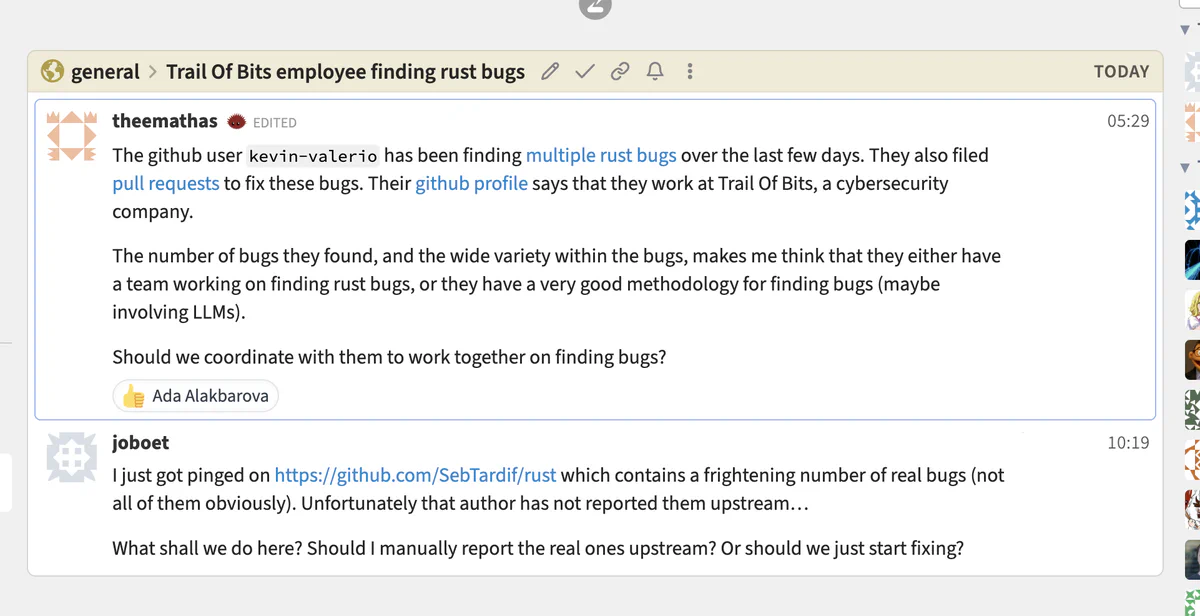
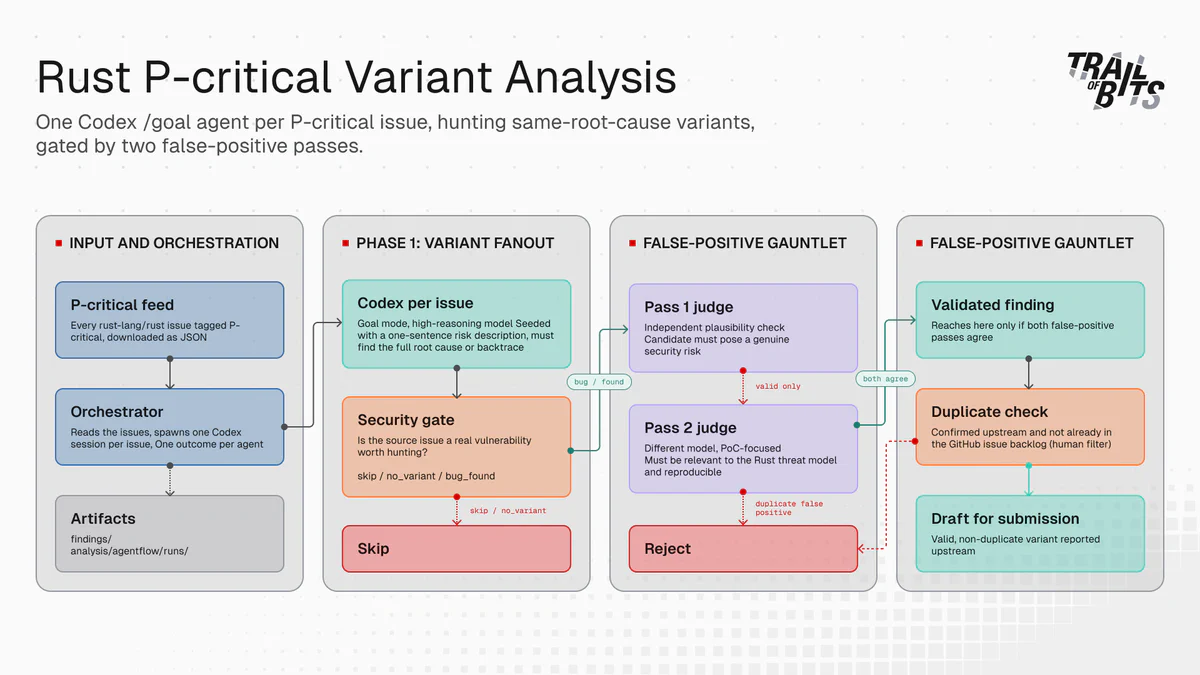
Codex’s /goal feature amplifies bug hunting, but getting good results requires the right prompt, the right scope, and the right number of outcomes per run. For Patch the Planet, our joint initiative with OpenAI to find and fix bugs in open-source software, we pointed Codex at some of the most widely used, heavily audited codebases in the world, like Rust, curl, and zlib. One tool came up again and again in our internal bug-report channels: /goal, which hands Codex an open-ended objective and lets it work independently toward a success condition. Here are a few highlights: /goal found every Rust bug we submitted, including a soundness hole and a miscompilation now patched in Rust 1.98, from a single variant-analysis pipeline. It turned every project’s past CVEs into Semgrep rules that had to fire on the vulnerable version and stay silent on the patched one, then flagged 11 variant hits across multiple projects. It uncovered two potential high-severity privilege-escalation bugs in Keycloak’s SAML component during a discovery run. Over the first few weeks of Patch the Planet, our engineers independently converged on three techniques for using /goal. We found that getting the most out of /goal means treating the prompt as a set of specific success criteria, not a set of instructions. (Note that this blog post uses /goal to refer to goal-based prompting in general. Codex can also set goals for itself through a tool call, and that’s how we recommend everyone use it; we rarely type the slash command ourselves.) 1. Let Codex write the goal The art of using /goal is prompt design, and we found that Codex knows Codex the best. Internally, our single most repeated /goal tip was to use Codex to help write each /goal prompt. We hand Codex threat model files and the context about what we’re looking for, and then tell it to write the goal prompt. As mentioned before, /goal is a tool Codex can invoke on itself, and a few engineers stopped typing goals by hand entirely. $goal-prompt based on threat model write goal to find single critical issue (RCE) exploitable by remote attacker for kubernetes-client. the kubernetes-client is used in normal config, malicious remote users exploits. Figure 1: A meta-prompt from one of our engineers asking Codex to create a goal prompt. Results are shown in figure 2. This works because Codex knows the target and its own tendencies better than we can specify up front. It can translate a threat model into concrete, testable success criteria, name the code paths worth prioritizing, and phrase the outcome precisely enough that a run actually converges. A goal written this way tends to be tighter than one we’d write cold, and it takes a fraction of the time. Letting the model draft the goal also closes a gap we’d otherwise miss. Any outcome you define can be satisfied in ways you didn’t intend, and the model is often the first to spot where the easy outs are. Now when we ask Codex to draft a goal, we ask it to red-team its…
Excerpt only, shown with attribution. This content belongs to the original publisher and has not been independently verified by CyberSecurity.pk.
More images
Keywords: vulnerabilityrceremote code executionkubernetesvulnerability newsTrail of Bits Blogcybersecurity newssecurity news Pakistan
Reference: Trail of Bits Blog — blog.trailofbits.com ↗