

supply-chain
Blog post
Introducing Patch the Planet
Source: Trail of Bits Blog · Published · Last checked 7 hours ago · 3 min read

Publisher excerpt From Trail of Bits Blog
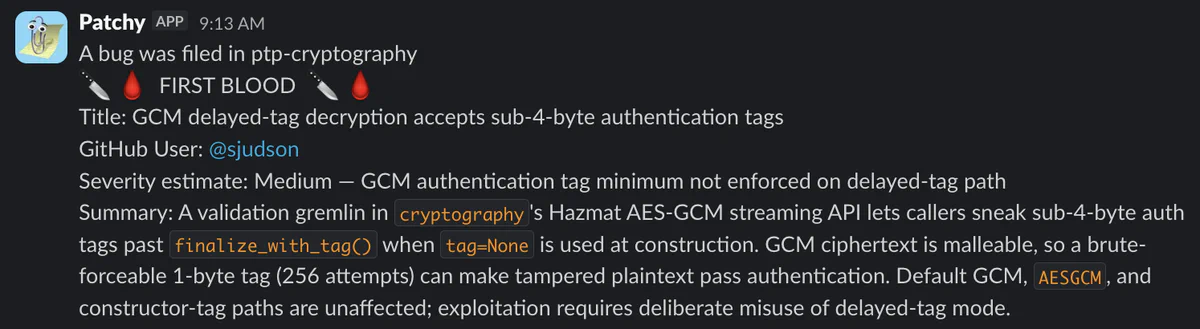
What happens when you clear dozens of Trail of Bits engineers’ schedules, pair them with every open-source maintainer they can contact, and unleash the latest frontier models like GPT-5.5-Cyber on critical open-source targets? Thanks to our partnership with OpenAI and its Daybreak initiative, we can report that the impact is hundreds of discovered bugs, 64 pull requests, and 51 issues filed across 19 projects (with many more still undergoing coordinated disclosure). That was just the first week of Patch the Planet. Frontier models like GPT-5.5-Cyber are producing a firehose of security findings, and already-stretched maintainers must sift through all of it to separate real vulnerabilities from plausible-sounding false positives. Patch the Planet is different: with our experts orchestrating and triaging findings, we handle the work of fixing and hardening the code alongside the people who maintain it. The first week of Patch the Planet covered 19 projects across cryptography, networking, language infrastructure, and software supply chain. Among these 19 projects were cURL, NATS, pyca, Sigstore, aiohttp, the Go project, freenginx, Python and python.org, urllib3, PyPI, SimpleX, Valkey, and RustCrypto. Over 30 projects have joined the initiative so far, and we’re rapidly expanding it to include more; if you maintain an open-source project, apply to join! Live look at the Trail of Bits engineering teams Anyone can file an issue, flex, and walk away. We showed up with the patches: 37 are already merged, and many more are in flight. These merges go beyond just fixing bugs: we’re adding new tests and fuzzing harnesses, CI security scanning, supply-chain tooling, correctness fixes, and features maintainers had been meaning to get to. The goal of Patch the Planet is to leave essential open-source projects measurably better off. We brought patches, not just bug reports We’re reporting public findings on GitHub, including 64 total pull requests. We also filed 51 issues, 19 of which are already closed with a fix. This public tally undercounts the work, since several projects take reports through private channels like HackerOne, GitHub security advisories, mailing lists, and private forks, and most of these have not been released publicly yet. What’s in those pull requests matters more than the count. At python.org, we added a CI workflow built on zizmor, an open-source GitHub Actions static analyzer, fixed all of the issues it flagged, and integrated it into their CI. In RustCrypto, we contributed correctness fixes to the big-integer library that higher-level cryptography is built on, alongside genuine feature work in review: serde encoding support and HPKE DHKEM suite IDs. Other patches were plain engineering help: storage-accounting and service-restart fixes in SimpleX, a clearer admin-quarantine confirmation in PyPI’s Warehouse, and supply-chain improvements like SBOM sidecars for Python’s Windows artifacts. We will also be upstreaming many testing…
Excerpt only, shown with attribution. This content belongs to the original publisher and has not been independently verified by CyberSecurity.pk.
More images



Keywords: rcesupply chainpypisupply chain newsTrail of Bits Blogcybersecurity newssecurity news Pakistan
Reference: Trail of Bits Blog — blog.trailofbits.com ↗